
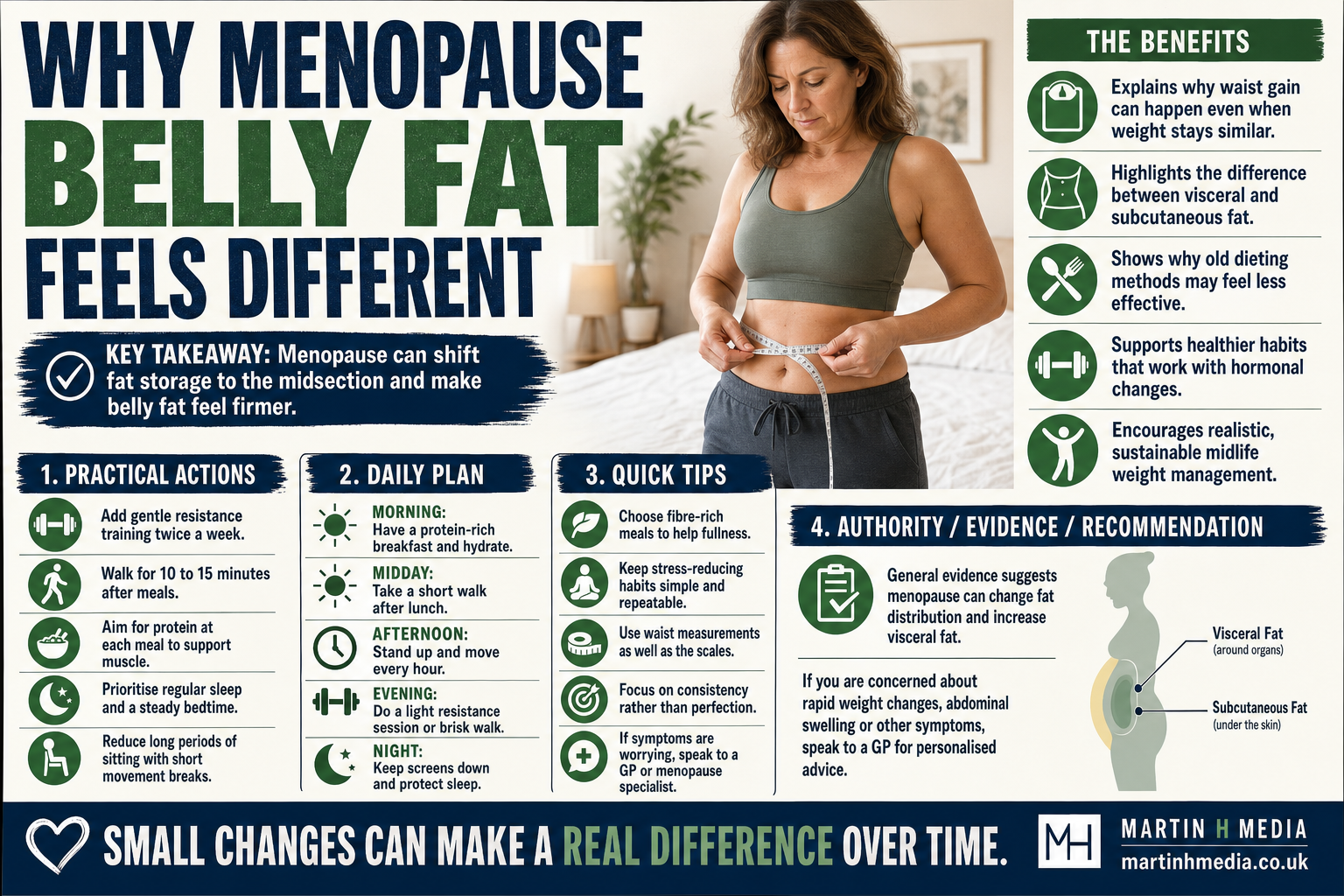
Why Menopause Belly Fat Won’t Respond to Your Old Diet
Why Menopause Belly Fat Feels Different starts the moment your jeans button strains. The scale hasn’t budged yet everything shifted forward. Your body stopped following the old weight-gain rules. Hormone changes rewired where and how you store fat.
Why Menopause Belly Fat Feels Different From Regular Weight Gain
Your weight might stay exactly the same. Your arms and legs could actually get thinner. But your waist expands by two clothing sizes anyway.
Some women maintain identical scale weight but shift body composition so dramatically they gain two waist sizes while limbs shrink. This isn’t water retention. It’s not bloating from dinner.
Before menopause most women carry a pear shape with fat concentrated around hips and breasts. After menopause body shape changes to apple shape with fat concentrated around the midsection. Evolution built women to store reserves in different places depending on reproductive status.
Estrogen promotes fat storage on hips and thighs but as it declines fat shifts to the midsection even when weight stays the same. Your body didn’t malfunction. Hormones changed the storage protocol.
The Physical Sensation Makes Why Menopause Belly Fat Feels Different Impossible To Ignore
Your belly feels firmer than it used to. You can’t pinch it the same way. The texture changed along with the location.
Visceral fat creates a firm distended feeling women describe as hard belly lying deep in the abdominal cavity. Subcutaneous fat sits just under the skin as pinchable muffin top. Menopause shifts storage from soft pinchable surface fat to deep firm internal fat.
Visceral fat rapidly increases in the three to five years before menopause onset. Subcutaneous fat increases gradually with aging and reduced activity. The timeline explains why belly changes feel so sudden and concentrated.
Visceral fat increases from 5 to 8 percent of total body fat premenopause to 15 to 20 percent postmenopause. That’s not a small shift. It’s a fundamental redistribution of where your body banks energy reserves.
Why Menopause Belly Fat Feels Different At The Cellular Level
Your fat cells themselves transformed. They got bigger and started behaving differently.
Menopause causes adipocyte hypertrophy with increased inflammation hypoxia and fibrosis in both fat types. Your fat tissue became inflamed and less responsive. This inflammatory adipose tissue creates insulin resistance and metabolic dysfunction.
Fat cells swelled larger instead of multiplying. Inflammation increased inside the tissue itself. Visceral fat acts like an endocrine organ releasing inflammatory cytokines that disrupt insulin sensitivity.
Postmenopausal women store significantly more visceral fat than premenopausal women at the same total fat mass. Two women at identical weights and body fat percentages have completely different internal fat distribution after menopause hits.
This cellular change explains why old diet tricks stopped working. The tissue itself operates under new rules now.
Your Body’s Response To Food Changed And That’s Why Menopause Belly Fat Feels Different
Menopause increases insulin resistance where cells become less responsive to insulin and blood sugar rises. Your cells stopped listening to the signal that says use this for energy.
Chronic stress and abdominal fat encourage insulin resistance where cells can’t use glucose so the body turns calories into fat even during dieting. The fat you already have makes it easier to store more. It’s a self-reinforcing cycle.
Visceral abdominal fat releases inflammatory cytokines that further impair insulin signaling and worsen blood sugar instability. Your belly fat actively sabotages your metabolism. It’s not passive storage anymore.
Menopause elevates baseline cortisol and postmenopausal women show significantly higher cortisol reactivity to stress correlating with impaired fasting glucose. Stress hormones stayed elevated longer. Recovery took more time.
Every meal became a potential fat storage event. Your hormone environment changed how you process breakfast and dinner alike.
Why Menopause Belly Fat Feels Different When You Try Standard Weight Loss
Traditional calorie approaches often fail during menopause because tissue itself became hormonally reprogrammed. You can’t math your way out of a hormone problem.
Cutting calories worked in your thirties. The same deficit does nothing now. Visceral fat cells contain more cortisol receptors than other fat and elevated cortisol makes these receptors attract and store more midsection fat.
Exercise intensity that once stripped fat now triggers cortisol spikes. Chronic stress leads to elevated cortisol increasing blood sugar and promoting fat storage particularly in the abdominal area. Your workout could be working against you.
Sleep disruption makes everything worse. Less estrogen decreases leptin and disrupted sleep increases ghrelin prompting the body to hold excess weight. Your hunger signals rewired themselves.
Natural approaches that work with hormonal changes produce better results than fighting your biology. Muscle-building strategies and smart meal timing address the root cause instead of symptoms.
The Health Risk Profile Explains Why Menopause Belly Fat Feels Different From A Medical Standpoint
Visceral fat is metabolically active and inflammatory increasing risk for cardiovascular disease type 2 diabetes and insulin resistance. Doctors care about this fat differently than surface fat.
Excessive subcutaneous fat is mostly cosmetic whereas elevated visceral fat is a significant metabolic risk factor. Your health markers changed even when the scale stayed stable.
Visceral fat turns the abdomen into an inflammatory organ. Your midsection started producing inflammatory compounds. It became biochemically active in ways that threatened long-term health.
Cardiovascular disease risk increases approximately 11 percent for every 10 cm increase in waist circumference. The measurement around your middle predicts health outcomes more accurately than total weight.
This isn’t vanity. It’s survival. Addressing menopause belly requires different strategies than cosmetic weight loss ever did.
Worth noting: your body adapted to survive without reproductive hormones by banking energy closer to vital organs.
Start with gentle resistance training twice weekly and walk after evening meals to interrupt the storage signals your hormones now send.
Frequently Asked Questions
Can you lose menopause belly fat without hormone replacement therapy?
Yes through resistance training, protein-focused eating, stress management and walking after meals. These methods work with your changed hormone environment instead of against it. Muscle building specifically counteracts the metabolic slowdown that makes belly fat stubborn during menopause.
Why does menopause belly feel hard instead of soft?
Visceral fat sits deep around internal organs creating firm distended sensation. Subcutaneous fat that sits under skin feels soft and pinchable. Menopause shifts storage from soft surface fat to firm deep visceral fat that you cannot grab.
How long does it take to see results with menopause belly fat?
Most women notice visible waist changes within three weeks of consistent daily walking. Resistance training shows metabolic improvements within six weeks. Results depend on sleep quality, stress levels and protein intake working together not just exercise alone.
Does menopause belly fat go away after hormones stabilize?
No, the fat doesn’t disappear automatically once menopause completes. Your new hormone baseline maintains the visceral fat unless you actively address it. The storage pattern remains until you change eating timing, build muscle and manage cortisol levels.
What makes menopause belly different from regular aging weight gain?
Regular aging causes gradual subcutaneous fat increase across the body. Menopause causes rapid visceral fat accumulation specifically in the abdomen within three to five years. The fat type, location, timeline and metabolic activity all differ fundamentally from normal aging.