
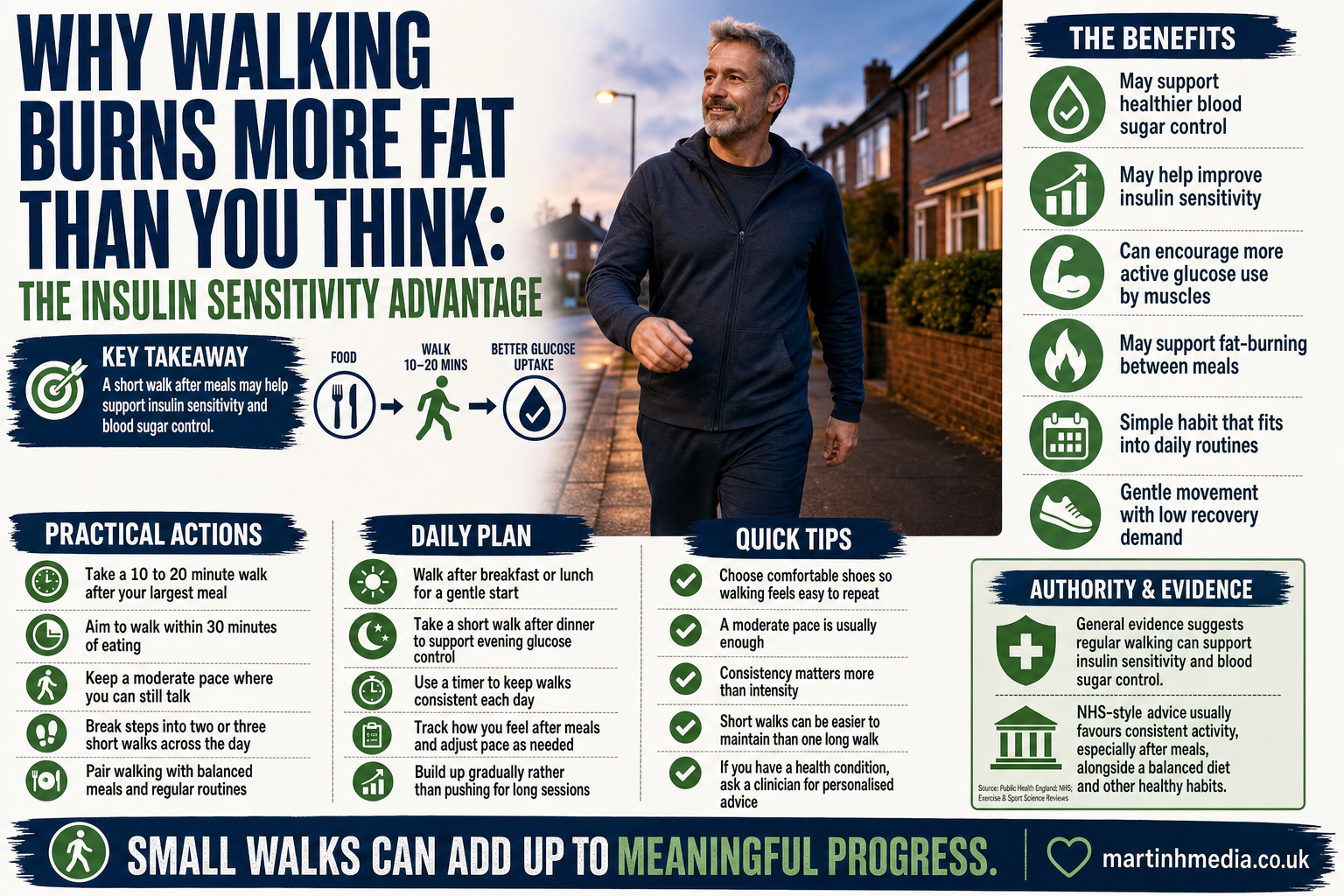
Walking Burns More Fat When You Fix This One Thing
You finish dinner and walk straight to the couch. Your blood sugar spikes while insulin floods your system. Fat burning shuts down completely for the next several hours. Why Walking Burns More Fat Than You Think: The Insulin Sensitivity Advantage changes this pattern instantly.
Why Walking Burns More Fat Than You Think: The Insulin Sensitivity Advantage Unlocks Your Fat Cells
Insulin acts as a gatekeeper for your fat stores. When insulin levels run high, your fat cells stay locked. Your body cannot access stored energy during these periods. This creates a frustrating cycle after every meal.
Your cells respond less effectively to insulin as you age. Your pancreas compensates by releasing even more insulin. The excess insulin keeps fat storage turned on longer. Walking breaks this cycle through a simple mechanism.
A twenty-minute walk after eating prevents the usual insulin spike. Your blood sugar rises gradually instead of surging. Your pancreas releases less insulin as a result. The difference shows up immediately in your bloodstream.
Research demonstrates that post-meal walks reduce insulin levels by thirty percent. This effect lasts for several hours after you stop moving. Your fat cells remain accessible during this entire window. Understanding how walking improves insulin response becomes especially important after age forty.
The Glucose Disposal Window Most People Ignore
Your muscles act as glucose sinks during movement. They pull sugar directly from your bloodstream without needing insulin. This happens through a completely separate pathway called GLUT4 translocation.
Sitting after a meal means all glucose must enter cells through insulin. Your pancreas works overtime to clear the sugar. Walking activates the muscle pathway instead. Your legs absorb glucose independently of hormonal signals.
This distinction matters more than most people realize. The muscle pathway doesn’t trigger fat storage signals. The insulin pathway does exactly that. You’re choosing which metabolic route to activate.
The effect compounds when you walk within thirty minutes of eating. Your muscles stay receptive to glucose for this specific window. Miss it and you default back to the insulin-dependent route. Timing determines which pathway dominates.
Why Walking Burns More Fat Than You Think: The Insulin Sensitivity Advantage Creates Metabolic Flexibility
Metabolic flexibility describes your body’s ability to switch between fuel sources. You should burn carbs when available and fat when not. Most people lose this ability over time. They stay locked in sugar-burning mode constantly.
High insulin levels prevent the switch to fat burning. Your body sees abundant insulin as a signal of plenty. It assumes carbs remain available. Fat stays stored even when you need energy.
Regular walking retrains your cells to respond to lower insulin levels. Your body learns it can function without constantly elevated hormones. The metabolic switch starts working again. You begin accessing fat between meals naturally.
This retraining happens gradually over several weeks. Each walk reinforces the pattern. Your cells rebuild their insulin sensitivity with consistent practice. The cumulative effect outweighs any single session.
The Post-Walk Fat Burning Extension
Walking creates an afterburn effect different from intense exercise. Your insulin stays suppressed for hours following moderate movement. This extended window allows continuous fat access. The benefit stretches far beyond your actual walking time.
Studies show insulin sensitivity improves for up to sixteen hours after walking. Your cells respond better to smaller amounts of insulin. Less hormone achieves the same glucose clearance. Fat burning stays available throughout this period.
Intense exercise can spike cortisol and disrupt this pattern. Your body interprets hard training as stress. Stress hormones interfere with insulin signaling. Walking avoids this complication entirely.
The gentle nature of walking triggers recovery responses instead. Your nervous system shifts toward rest and digest mode. Insulin sensitivity improves under these conditions. Fat metabolism runs smoothly without stress interference.
Why Walking Burns More Fat Than You Think: The Insulin Sensitivity Advantage Beats Fasting Alone
Many people try fasting to lower insulin levels. This works to some degree. Your insulin drops when you stop eating. Walking amplifies this effect several times over.
Fasting while sedentary still leaves you insulin resistant at the cellular level. Your cells don’t respond well even to low insulin. Adding movement improves the cellular response directly. You get better results from the same fasting window.
A fasted morning walk creates the ideal fat burning environment. Your insulin starts low from overnight fasting. Walking drives it even lower while improving cellular sensitivity. Your body accesses fat stores with minimal resistance.
This combination works better than either strategy alone. Fasting controls insulin supply. Walking improves insulin demand. You’re addressing both sides of the equation simultaneously.
The Seven Thousand Step Sweet Spot
More steps don’t always mean better results. Research identifies seven thousand daily steps as optimal for metabolic health. Going beyond this point shows diminishing returns. The relationship isn’t linear.
Seven thousand steps provide enough movement to maintain insulin sensitivity. Your muscles get adequate stimulation without triggering stress responses. You stay in the beneficial zone. Pushing to fifteen thousand steps may actually reduce fat burning efficiency.
Excessive walking raises cortisol in some people. This stress hormone makes cells more insulin resistant. You’re working against yourself at that point. Finding your personal threshold matters more than chasing arbitrary numbers.
Most people find three to four shorter walks easier than one long session. This approach keeps insulin suppressed throughout the day. You create multiple fat burning windows instead of one. The distribution pattern enhances the overall effect.
Why Walking Burns More Fat Than You Think: The Insulin Sensitivity Advantage Works Through Muscle Activation
Your leg muscles contain the largest glucose storage capacity in your body. Activating these muscles creates significant metabolic demand. Each step contracts your quadriceps and glutes repeatedly. This constant activation improves how muscles handle glucose.
Muscle cells that contract regularly build more insulin receptors. More receptors mean better insulin sensitivity. Better sensitivity means lower insulin requirements. Lower insulin equals more fat burning. The chain reaction starts with simple muscle contraction.
Walking preserves existing muscle mass through continuous low-level tension. You don’t break down tissue like intense training does. You maintain the metabolic machinery without requiring extensive recovery. This matters especially as recovery capacity decreases with age.
The blood flow increase during walking delivers nutrients directly to muscles. Oxygen and glucose reach tissue more efficiently. Your muscles stay metabolically active and responsive. This maintains the insulin sensitivity benefit long term.
The Meal Timing Strategy Nobody Mentions
Your largest meal creates your biggest insulin challenge. Walking after this meal provides the greatest benefit. Most people eat their biggest meal at dinner. A post-dinner walk becomes the most important movement of your day.
Evening insulin spikes cause overnight fat storage. Your body shuttles excess energy into fat cells while you sleep. Walking after dinner prevents this entire process. You clear glucose before lying down for hours.
Morning walks work differently but remain valuable. They improve insulin sensitivity before you eat anything. Your first meal of the day gets processed more efficiently. You set a positive metabolic tone for hours ahead.
Combining both strategies covers your full day. Morning walks prime your metabolism. Evening walks prevent dinner storage. You’re managing insulin from both directions. The complete approach to walking for fat loss addresses timing as much as duration.
Why Walking Burns More Fat Than You Think: The Insulin Sensitivity Advantage Requires Consistency Over Intensity
Missing three days of walking reverses some insulin sensitivity gains. Your cells start becoming resistant again quickly. The benefit builds with daily practice. Sporadic effort produces sporadic results.
Daily walks maintain the cellular adaptations you’ve built. Your insulin receptors stay active and numerous. Your muscle glucose uptake pathways remain open. Consistency preserves these changes better than occasional long walks.
A fifteen-minute daily walk beats a single hour-long weekend walk. The frequent stimulus keeps your metabolism responsive. Your cells expect regular movement and adapt accordingly. Breaking the pattern signals your body to reverse the adaptations.
Think of walking as metabolic maintenance rather than exercise. You’re keeping systems running smoothly. The cumulative effect over months matters more than any single session. Building sustainable walking habits after forty focuses on daily practice.
Start with a ten-minute walk after your largest meal today.
Frequently Asked Questions
How soon after eating should I walk for best insulin benefits?
Walk within thirty minutes of finishing your meal. This timing captures the glucose disposal window when muscles absorb sugar most efficiently. Waiting longer means insulin has already processed most of the glucose. Earlier walks provide better blood sugar control and lower insulin response.
Can walking replace other exercise for fat loss after forty?
Walking provides excellent metabolic benefits but works best combined with strength training. Walking manages insulin and preserves existing muscle. Strength training builds muscle that increases your baseline calorie burn. Both strategies complement each other for comprehensive fat loss after forty.
Does walking speed matter for insulin sensitivity improvements?
Moderate pace works better than slow strolling or fast power walking. Aim for a pace where you can talk but feel slightly breathless. This intensity activates muscles enough to improve glucose uptake without triggering stress responses. Speed matters less than consistent daily movement.
How long before I notice fat loss from daily walking?
Insulin sensitivity improves within two weeks of daily walking. Visible fat loss typically appears after four to six weeks. The metabolic changes happen first at the cellular level. Physical changes follow once your body sustains lower insulin levels consistently.
Should I walk before breakfast or after for fat burning?
Both times offer different benefits. Fasted morning walks maximize fat burning during the walk itself. Post-meal walks prevent insulin spikes and fat storage. Walking after your largest meal provides the greatest overall metabolic advantage throughout the day.