
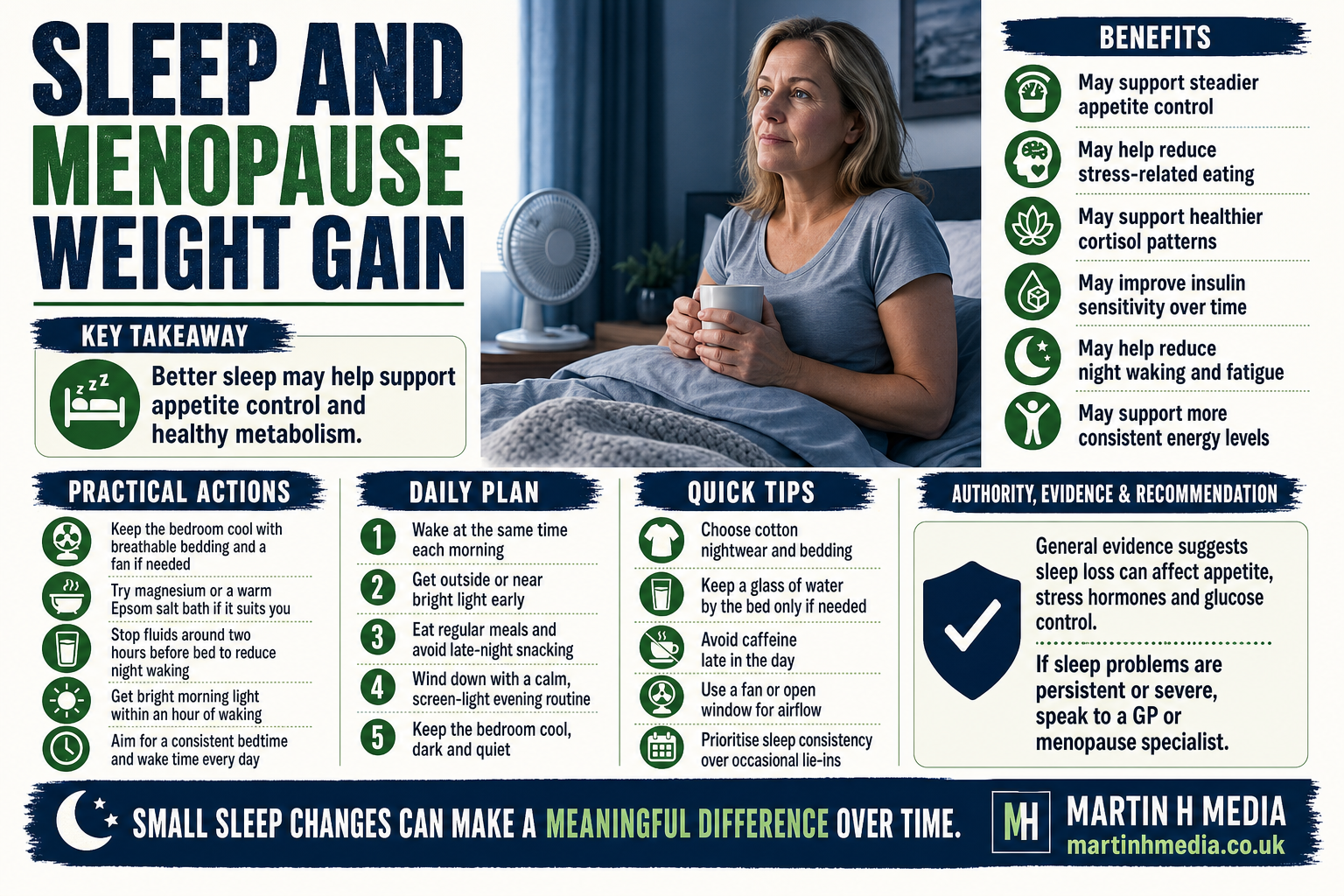
Why Poor Sleep During Menopause Sabotages Your Metabolism
The connection between sleep and menopause weight gain affects millions of women nightly. Your waistline responds more to sleep hours than your gym hours. Poor sleep triggers specific hormones that command your body to store fat. Good rest changes everything.
How Sleep and Menopause Weight Gain Form a Biological Loop
Sleep disturbances during menopause contribute to changes that predispose midlife women to weight gain. Your body doesn’t just feel tired. It rewrites metabolic instructions.
Sleep disturbance experienced in menopause affects how your body uses fat. Fat burning slows down. Storage speeds up. This happens at the cellular level.
Poor sleep accelerates the process of fat storage toward the abdomen during estrogen decline. The combination hits harder than either problem alone. Your middle section becomes the primary storage zone.
Half of women during menopause experience sleep problems. Sleep disturbance has independently been linked to metabolic changes that increase weight gain risk. This isn’t random bad luck. It’s predictable biochemistry.
Sleep and Menopause Weight Gain Through Hunger Hormone Disruption
Less than seven to eight hours of sleep triggers hormone production that creates cravings for sugar and fatty foods. Your appetite controls break down. Fullness signals stop working properly.
Sleep-deprived women gravitate toward simple carbohydrates and sugar because bodies seek the fastest available energy source. You’re not weak. Your hormones are screaming for immediate fuel.
Sleep restriction increases ghrelin and hunger while decreasing leptin and fullness. Ghrelin makes you want to eat. Leptin tells you to stop. Poor sleep reverses the balance completely.
These hormone shifts drive evening eating. Sleep restriction increases food intake, especially in the evening, in excess of energy balance requirements. You consume more calories than you burn. Weight gain follows naturally.
Women respond differently than men to sleep loss. Women increase food consumption and experience weight gain during insufficient sleep while maintaining weight during adequate sleep. Managing menopause belly naturally requires addressing these specific female metabolic responses.
Cortisol Elevation Links Sleep and Menopause Weight Gain
Poor sleep drives up cortisol, which disrupts appetite hormones, slows metabolism, and encourages belly fat storage. Cortisol functions as your stress hormone. Sleep deprivation counts as physical stress.
Chronically elevated cortisol drives fat storage around the abdomen and stimulates appetite, with sleep deprivation triggering cortisol spikes the following day. The cycle continues daily. Each bad night programs your body to store more fat.
Poor sleep both elevates cortisol and results from elevated cortisol. This creates a reinforcing loop. High cortisol prevents deep sleep. Poor sleep raises cortisol higher.
Breaking this pattern matters more than cutting calories. When progesterone falls, women experience increased anxiety, sleep disturbances, and heightened stress responses that elevate cortisol further. Three separate hormone systems work against you simultaneously.
Sleep helps lower stress hormones like cortisol and supports healthy metabolism. The reverse is equally true. Better sleep becomes a weight loss tool by itself.
Insulin Resistance Connects Sleep and Menopause Weight Gain
Consistently consuming high-sugar and high-carbohydrate foods leads to insulin resistance over time, making weight gain easier and weight loss more challenging. Sleep deprivation pushes you toward exactly these foods.
Inadequate sleep increases fasting blood sugar levels, with even single nights of partial sleep deprivation showing increased insulin resistance. One bad night changes how your body processes food the next day. Your cells stop responding properly to insulin.
This matters for fat storage location. High cortisol impairs insulin sensitivity, leading to higher blood sugar and more fat storage. Abdominal fat cells are especially sensitive to insulin and cortisol signals together.
Poor sleep quality relates to decreased glucose tolerance, decreased insulin sensitivity, and increased hunger and appetite. All four problems compound each other. Your metabolism shifts into storage mode.
The timeline accelerates during menopause. Hormone changes already reduce insulin sensitivity. Poor sleep makes it dramatically worse. Understanding hormone-friendly approaches means treating sleep as seriously as food choices.
Sleep Quality Measurements Show Sleep and Menopause Weight Gain Patterns
Rates of poor sleep quality in postmenopausal women reach 30.2% compared to 14.4% in premenopausal women. The problem more than doubles after menopause. This isn’t normal ageing.
Sleep efficiency was found to be 93.4% in young women, 84.3% in perimenopausal women, and 80.2% in postmenopausal women. You spend more time in bed but less time actually sleeping. The gap between time in bed and quality sleep grows.
Worse sleep assessed via electroencephalogram associates with metabolic syndrome and higher adiposity among menopausal women. Brain wave measurements prove the sleep is genuinely lighter. It’s not just subjective feeling.
Body mass index shows significant correlation with undesired sleep quality. Higher weight predicts worse sleep. Worse sleep predicts higher weight. The relationship runs both directions.
Sleep architecture changes fundamentally. Wake time after sleep onset associates with multiple sleep stage transitions and cortical arousal, even with normal total sleep time. You might log eight hours but never reach deep restorative stages.
Practical Solutions for Sleep and Menopause Weight Gain
Temperature control prevents the most common sleep disruptions. Cotton nightwear and bed linen help with overheating, and keeping windows slightly open or using a fan near the bed can help. Hot flashes wake you repeatedly. Cooler sleeping environments reduce these interruptions.
Magnesium addresses the relaxation problem directly. Taking magnesium orally or via an Epsom salt bath can help aid relaxation. Your nervous system needs this mineral to calm down. Menopause often depletes it.
Timing your last drink matters more than you think. Drinking after around 10pm triggers waking to use the toilet, and even without needing the toilet, the brain gets into a ‘just in case’ wake up habit. Stop fluids two hours before bed.
Morning light exposure resets disrupted rhythms. Your circadian clock needs recalibration during menopause. Following menopause, many people experience a weakening of their circadian rhythms. Bright light within an hour of waking helps restore natural patterns.
Consistent sleep timing outperforms sporadic long sleep sessions. Prioritizing sleep should result in better sleep consistency, more energy during the day, and less afternoon crash. Your body needs predictable patterns to restore hormone balance. Building steady habits around sleep supports the waistline changes that matter most.
Address sleep problems now to prevent weight gain from accelerating over the next decade.
Frequently Asked Questions
Does menopause cause sleep problems or does poor sleep cause menopause weight gain?
Both happen simultaneously. Dropping estrogen disrupts sleep architecture and increases night waking. Poor sleep then triggers cortisol elevation and hunger hormone imbalances that drive weight gain. The relationship works in both directions, creating a reinforcing cycle where each problem worsens the other.
How many hours of sleep do I need to prevent menopause weight gain?
Seven to eight hours of quality sleep prevents the hormone disruptions that trigger weight gain. Less than seven hours consistently elevates ghrelin, increases cortisol, and reduces insulin sensitivity. Sleep duration matters, but so does quality. Fragmented sleep with frequent waking produces similar metabolic problems even with adequate time in bed.
Can improving sleep alone reduce menopause belly fat?
Better sleep reduces cortisol levels, improves insulin sensitivity, and normalizes hunger hormones. These changes slow new fat storage and make existing fat easier to lose. Sleep improvement works best combined with appropriate food timing and gentle movement, but it functions as a genuine weight management tool by itself.
Why do hot flashes disrupt sleep and cause weight gain?
Hot flashes wake you multiple times nightly, preventing deep restorative sleep stages. Each waking triggers brief cortisol spikes. Night after night, these accumulated cortisol elevations signal your body to protect abdominal fat stores. The sleep fragmentation also disrupts next-day appetite control and increases evening food intake.
What sleep changes show the strongest connection to menopause weight gain?
Frequent middle-of-the-night waking shows the strongest correlation with metabolic changes and abdominal fat gain. Wake time after sleep onset matters more than total sleep time. Women who wake repeatedly but stay in bed eight hours face similar weight gain risks as women sleeping only five hours straight.