
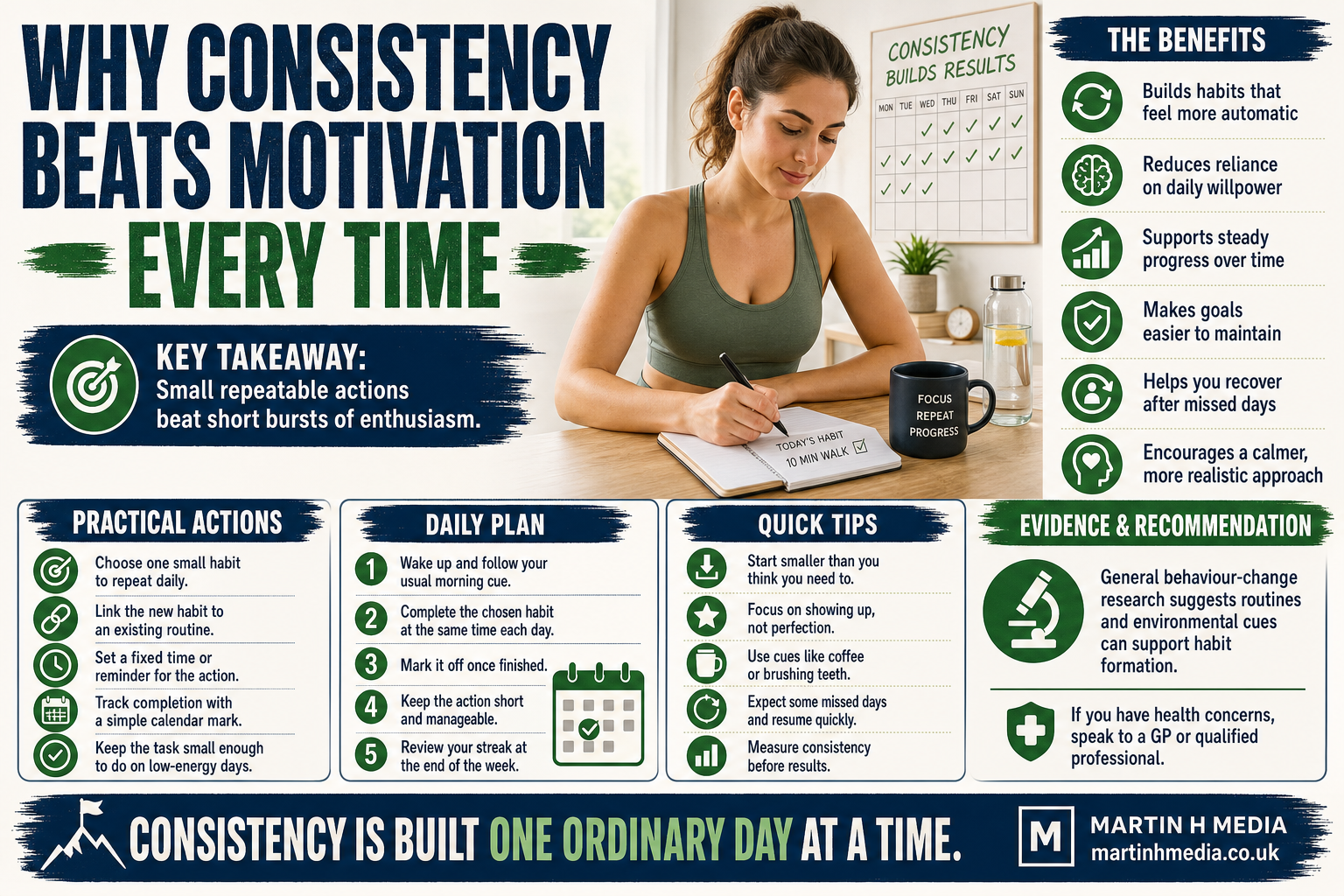
The Motivation Trap: Why Your Willpower Is Sabotaging Progress
You tell yourself Monday will be different. You feel pumped for two days. Then normal life returns and your plan disappears. Why Consistency Beats Motivation Every Time is simple: motivation fades but systems stay.
Why Consistency Beats Motivation Every Time in Building Automatic Behavior
Your brain doesn’t care about your feelings. It follows patterns you repeat without thinking. Motivation asks you to decide every single time. Consistency removes the decision completely.
Think about brushing your teeth. You don’t wait to feel excited about it. You don’t need a motivational video first. You just do it at the same time every day. The behavior runs on autopilot.
The same principle applies to any goal you set. Walking each morning at 6:30 becomes automatic after three weeks. Writing for fifteen minutes after coffee stops needing willpower. Your body moves before your mind can argue.
Motivation works differently. It depends on your mood and energy level. Some days you feel ready to conquer everything. Other days you feel like staying in bed. The gap between those days kills your progress.
Automatic behavior doesn’t check your mood first. It triggers from environmental cues you’ve built into your routine. The alarm goes off and you walk. The coffee finishes and you write. No negotiation happens.
Most people wait for inspiration to strike. They start projects when excitement runs high. Then they stop when the feeling disappears. Six weeks later they start over from zero.
This cycle wastes years. You never build momentum because you keep restarting. Consistency compounds small actions into major changes. Missing one day doesn’t matter. Missing the pattern does.
The Energy Cost of Relying on Motivation
Every decision drains mental energy. Your brain has limited capacity for choices each day. Motivation forces you to choose every single time you act.
Should I work out today? Do I feel like it? Maybe I’ll wait until tomorrow. These questions consume energy before you even start. Most days you’ll talk yourself out of it.
Consistent systems eliminate these questions. You don’t debate whether to walk. You walk at 7 AM every Tuesday and Thursday. The decision was made once when you built the system.
Research shows willpower depletes throughout the day. Morning decisions come easier than evening ones. Relying on motivation means fighting your biology. You’re trying to choose correctly when your brain is already tired.
A structured weekly walking plan removes this fight. The schedule exists outside your daily mood. You follow it regardless of how you feel.
Think about successful people in any field. They don’t feel motivated every day. They show up anyway because their routine demands it. The work happens before feelings get involved.
Your motivation will fail you. Accept this truth now. Build systems that work even when you feel nothing. That’s where real progress lives.
Why Consistency Beats Motivation Every Time for Reaching Long Term Goals
Big goals need months or years to achieve. Motivation can’t sustain that duration. It burns bright for days then fades to nothing.
Losing twenty pounds takes consistent effort over three months. Writing a book requires showing up for six months. Building a business demands years of steady work. Motivation doesn’t last that long.
Consistency accumulates tiny improvements into massive results. Walking twelve minutes daily seems insignificant. After ninety days it transforms your body composition. The magic happens through repetition, not intensity.
Most people overestimate what they can do in one week. They underestimate what they can do in one year. Motivation drives the sprint. Consistency wins the marathon.
Your brain also learns through repetition. One motivated workout teaches little. Fifty consistent workouts rewire your neural pathways. The behavior becomes part of your identity.
You stop being someone who tries to exercise. You become someone who walks every morning. The shift from effort to identity changes everything. Identity doesn’t need motivation to maintain itself.
Short bursts of motivated action create temporary results. You lose five pounds then gain seven back. Consistent daily habits create permanent change. The results stick because the behavior never stops.
How Motivation Creates False Confidence
Feeling motivated tricks you into overcommitting. You promise yourself you’ll work out every day. You’ll write for two hours. You’ll completely change your diet overnight.
These promises feel real when motivation runs high. Your brain believes the excitement will last forever. It won’t. Three days later you’ll feel normal again.
Then you face a choice. Keep the impossible promise or quit entirely. Most people quit because the promise was too big. They feel like failures for not maintaining motivation.
Consistency starts smaller. Walk for twelve minutes three times this week. That’s achievable even on bad days. Success builds confidence better than broken promises do.
Motivation makes you focus on the outcome. You imagine how great you’ll look in three months. This creates pressure and anxiety. The gap between current and desired feels overwhelming.
Consistent systems focus on the next action. You don’t think about twenty pounds. You think about today’s walk. The outcome takes care of itself through accumulated action.
Many women following a planned walking schedule see better results than those doing intense random workouts. The plan removes the need for constant motivation. The schedule just runs.
Why Consistency Beats Motivation Every Time When Life Gets Hard
Easy weeks don’t test your system. Everything works when conditions stay perfect. Life rarely stays perfect for long.
You get sick. Work explodes. Family needs attention. A crisis hits from nowhere. Motivation disappears completely during these times. You’re just trying to survive the day.
This is where consistency proves its value. Your system has flexibility built in. Missing one scheduled walk doesn’t break the pattern. You return to it automatically once things calm down.
Motivation based plans collapse under pressure. You miss three days and feel guilty. The guilt makes starting again harder. You avoid it completely because you’ve already failed.
Consistent routines expect disruption. They don’t demand perfection. The goal is to maintain the pattern over months, not execute perfectly every week. Two walks are better than zero.
Your body also responds better to regular input. Sporadic intense effort creates stress hormones. Steady moderate effort keeps hormones balanced. This matters especially for goals like reducing belly fat during menopause.
The real test comes on day ninety. Motivation will be gone. Your initial excitement will feel distant. But your routine will still be running. That’s when you realize consistency already won.
Building Systems That Replace Motivation
Start by choosing one behavior to make automatic. Not five goals. One specific action you can repeat.
Attach it to an existing habit. After you pour coffee, you walk. When you brush teeth, you do stretches. The existing habit triggers the new one. Your brain links them together quickly.
Set an alarm for the exact same time each day. The external trigger removes the need to remember. You’re not relying on motivation or memory. The phone tells you when to act.
Make the action small enough that you can’t fail. Twelve minutes of walking works better than planning an hour. You can always do twelve minutes. An hour gives you excuses.
Track completion without judging performance. Put an X on the calendar for each day you do it. The chain of Xs becomes motivation to continue. You’re not tracking quality or results yet.
A proven approach like a specific weekly walking structure takes the guesswork out completely. The system already exists. You just follow it. No decisions needed.
After three weeks the behavior starts feeling automatic. After six weeks you feel weird skipping it. After twelve weeks it’s part of who you are. The system replaced motivation completely.
Most people never reach week twelve. They restart every few days chasing motivation. Break this pattern now. Pick your system and follow it regardless of feelings.
Why Consistency Beats Motivation Every Time in Creating Identity Change
Your actions prove who you are. One workout proves nothing. Fifty workouts prove you’re someone who exercises regularly.
Identity changes behavior more powerfully than goals do. Someone who identifies as a writer writes daily. Someone who identifies as healthy makes different food choices automatically.
Motivation tries to change behavior without changing identity. You want the outcome without becoming the person. This creates internal conflict. Your actions and identity fight each other.
Consistency builds identity through repeated proof. Each completed walk confirms you’re someone who walks. The evidence accumulates until your brain accepts the new identity.
This shift happens quietly around week eight. You stop thinking about whether to walk. You just think about when to walk. The question changed from if to when.
Once identity shifts, the behavior becomes effortless. You’re not trying to act differently. You’re acting according to who you are. Motivation never enters the equation.
People who succeed long term always make this shift. They become the person who does the thing. Everyone else stays stuck trying to feel motivated enough.
Choose systems now that build the identity you want later.
Frequently Asked Questions
How long does it take for consistency to replace motivation?
Most people need three weeks to establish a basic habit. The behavior feels automatic after six to eight weeks. Full identity shift happens around twelve weeks of consistent action. Missing occasional days doesn’t reset the timeline as long as the pattern continues.
What should I do when I don’t feel motivated at all?
Follow your system anyway but make it smaller. Planned twelve minutes of walking? Do six minutes instead. Showing up matters more than performance. The pattern stays intact even when the effort shrinks. You can always extend it once you start.
Can I rely on motivation to start building consistency?
Yes. Use initial motivation to design your system and start the pattern. Motivation helps during the first week when everything feels new. Just don’t expect it to last beyond two weeks. Build your system while you have energy to think clearly.
Why do I keep restarting instead of staying consistent?
You’re probably setting goals too big for bad days. Your system needs to work even when life gets hard. Scale back until the action feels almost too easy. Consistency at a lower level beats stopping and restarting at a higher level.
How do I measure progress without relying on motivation?
Track the behavior itself, not the outcome. Mark each day you complete the action. Count weekly streaks. Measure how automatic the behavior feels over time. Results come later as a side effect of maintained consistency.