

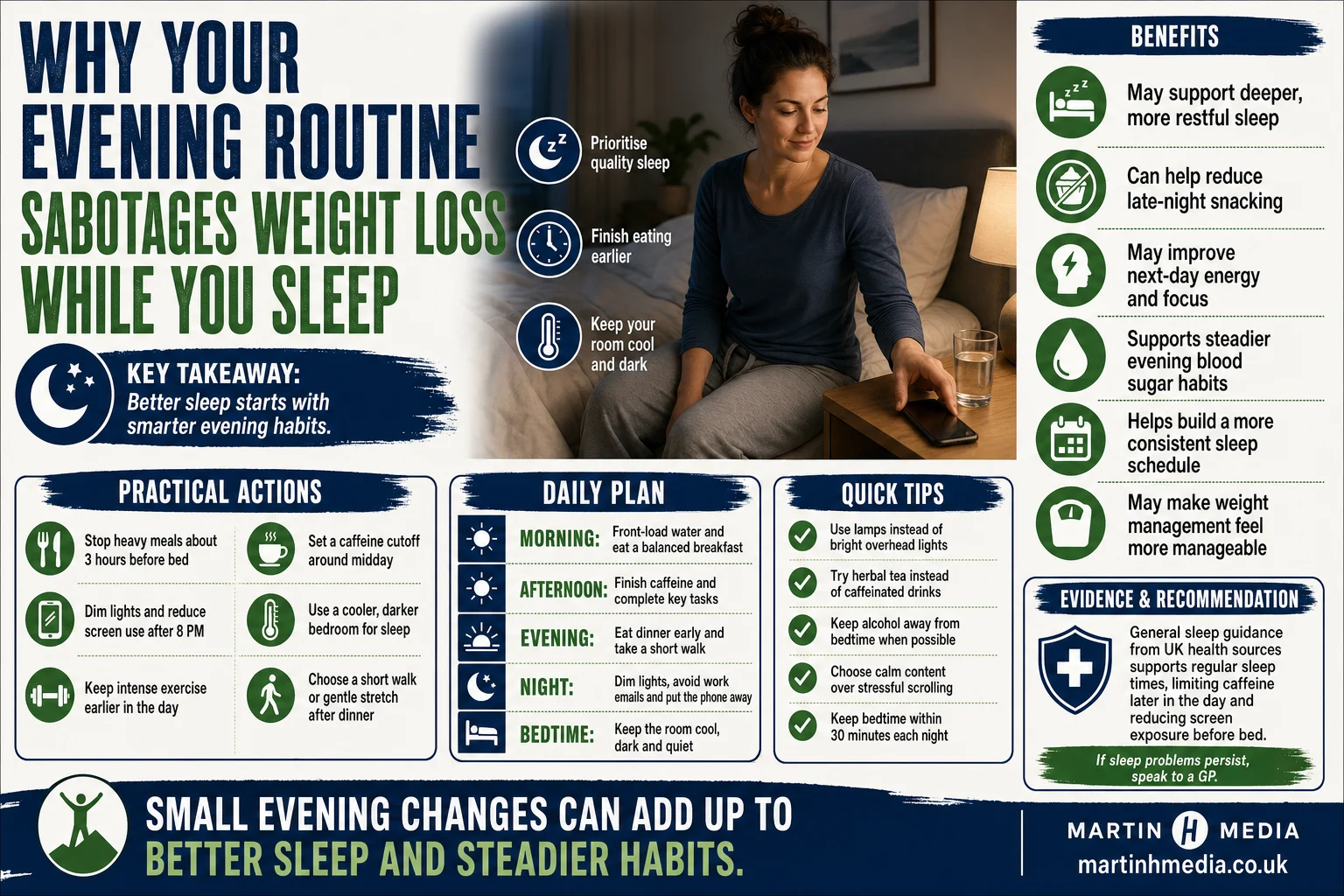
You scroll through social media at 11 PM. Your bedroom glows blue from the screen. Evening Routines That Promote Better Sleep and Support Weight management begin three hours before bed. The actions you take after dinner determine tomorrow’s energy.
Evening Routines That Promote Better Sleep: The Digestion Window
Your last meal needs three hours to move through initial digestion. Lying down before this window closes forces stomach acid upward. Sleep quality drops by nearly 40 percent when you eat within two hours of bed.
Stop eating by 7 PM if you sleep at 10 PM. Your body temperature needs to drop for deep sleep. Active digestion keeps internal temperature elevated. This single timing shift improves sleep depth measurably.
Heavy proteins take longest to digest. Fish and eggs move through faster than beef. Carbohydrates process quickest but spike blood sugar when eaten alone at night.
Hunger at bedtime means you underate during the day. Fix your breakfast and lunch portions. Don’t try to catch up after 6 PM.
The Light Exposure Strategy
Your brain produces melatonin based on light signals. Blue wavelengths from screens suppress this hormone completely. Most people stare at phones until they close their eyes.
Dim your home lights after 8 PM. Use lamps instead of overhead fixtures. Your circadian rhythm interprets bright ceiling lights as midday sun.
Orange or red bulbs work better than white. They don’t trigger the photoreceptors that block melatonin. Darkness tells your brain that sleep approaches.
Put your phone in another room at 9 PM. Charge it in the kitchen overnight. This removes the temptation to check it before bed.
Reading from a backlit screen ruins sleep preparation. Physical books don’t emit light toward your eyes. E-readers with front lighting work acceptably if you dim them fully.
Evening Routines That Promote Better Sleep: Temperature Control
Your core body temperature must drop 2 to 3 degrees for sleep onset. Most bedrooms stay too warm for this to happen naturally. The ideal sleep temperature sits between 60 and 67 degrees Fahrenheit.
Hot showers seem relaxing but they raise core temperature. Take your shower two hours before bed instead. The cooling period afterward actually promotes drowsiness.
Cold showers work differently. They trigger immediate temperature regulation responses. Your body overcompensates by warming itself afterward. This disrupts the cooling needed for sleep.
Keep your bedroom colder than feels comfortable while awake. Use blankets to stay warm. You can adjust covers during sleep naturally. You cannot adjust room temperature without waking fully.
Sleeping in socks helps some people. Warm extremities signal your body to cool your core. This sounds backwards but the physiology works.
Evening Routines That Promote Weight Management: Movement Timing
Exercise raises cortisol and adrenaline for hours afterward. Late workouts keep these hormones elevated past bedtime. Your body stays in activation mode when it needs rest mode.
Finish intense exercise by 6 PM. This gives four hours for stress hormones to decline. Walks don’t count as intense exercise for this purpose.
A 15-minute walk after dinner improves both sleep and weight control. Movement helps clear glucose from your bloodstream. Blood sugar stability leads to better sleep quality overnight.
Walk outside if possible. Indoor walking works but provides no light exposure benefits. Evening daylight helps set your circadian rhythm for the next morning.
Stretching before bed reduces physical tension without raising heart rate. Five minutes of gentle movement prevents the stiffness many people feel upon waking. Just like quick daily habits that compound, brief evening stretches add up.
The Caffeine Cutoff
Caffeine has a half-life of six hours in most adults. One cup at 4 PM means half that caffeine remains at 10 PM. Your body still processes a quarter of it at 4 AM.
Set your last coffee for noon. This seems extreme until you try it for one week. Sleep depth improves noticeably even if you fall asleep fine with afternoon caffeine.
Tea contains less caffeine but still interferes with sleep architecture. Green tea has enough caffeine to disrupt deep sleep cycles. Herbal teas contain zero caffeine and work well in evening routines.
Decaf coffee isn’t caffeine-free. It contains about 7 mg per cup compared to 95 mg in regular. This amount still affects sensitive individuals negatively.
Energy drinks and sodas hide significant caffeine content. Read labels carefully. Many contain 150 to 300 mg per serving.
Evening Routines That Promote Better Sleep: The Alcohol Truth
Alcohol makes you drowsy initially. This feels like it helps sleep. The metabolism of alcohol disrupts sleep cycles three to four hours later.
You fall asleep faster with alcohol in your system. You wake up more frequently after 2 AM. REM sleep gets cut short repeatedly. Morning grogginess comes from fragmented sleep architecture.
One drink takes about two hours to metabolize completely. Two drinks need four hours. Calculate backward from your bedtime to find your cutoff.
Wine before bed spikes blood sugar then crashes it overnight. The crash triggers cortisol release. This stress hormone wakes you partially even without full consciousness.
Skip alcohol entirely on nights before important days. Your sleep quality matters more than the temporary relaxation feeling.
Screen Content Matters
The type of content you watch affects sleep as much as blue light. Exciting shows raise your heart rate and mental arousal. Your brain stays activated long after you stop watching.
Action movies and thrillers work against sleep preparation. Documentaries and calm shows cause less arousal. Boring content actually helps transition toward sleep.
News consumption before bed raises anxiety measurably. Most news focuses on threats and problems. Your brain processes these as personal dangers.
Social media scrolling triggers unpredictable emotional responses. You never know what you’ll see next. This uncertainty keeps your mind alert and scanning.
Work emails after 8 PM guarantee poor sleep. Problems discovered at night occupy your mind for hours. Morning review gives you time to act instead of just worry.
Evening Routines That Promote Weight Control: Hydration Timing
You need adequate daily water but timing matters for sleep quality. Drinking large amounts after 7 PM guarantees nighttime bathroom trips. Interrupted sleep affects hunger hormones the next day.
Front-load your water intake before 3 PM. Get 70 percent of your daily total by mid-afternoon. Sip small amounts in the evening only.
Dehydration also disrupts sleep through different mechanisms. Dry mouth and nasal passages cause discomfort. Find the balance for your body through experimentation.
Herbal tea counts toward hydration but adds liquid volume. One cup after dinner works fine. Three cups will wake you up at 2 AM.
Your body loses water overnight through breathing. Some thirst in the morning is normal. Extreme thirst suggests you need more daytime water.
The Bedroom Environment
Your sleeping space should serve one purpose only. Working in bed confuses your brain’s location-based triggers. Your mind associates the bed with alertness instead of rest.
Remove the television from your bedroom completely. Entertainment devices signal activity time to your brain. The bedroom needs strong associations with sleep only.
Blackout curtains block external light sources. Street lights and early sunrise disrupt sleep cycles. Complete darkness improves melatonin production significantly. Similar to small adjustments that take minimal time, fixing your light exposure requires little effort.
White noise machines mask unpredictable sounds. Your brain monitors for threats during sleep. Random noises cause partial waking even without conscious awareness.
Keep your bedroom clean and uncluttered. Visual chaos creates low-level stress. Your environment affects mental state more than most people realize.
Evening Routines That Support Weight Goals: The Consistency Factor
Your body runs on circadian rhythms tied to consistent timing. Going to bed at different times confuses these internal clocks. Sleep quality suffers even with adequate total hours.
Pick one bedtime and stick to it within 30 minutes. Weekends included. Your biology doesn’t recognize social calendars.
Wake time matters even more than bedtime for rhythm setting. Set your alarm for the same time daily. Your bedtime will naturally adjust earlier after several days.
Sleep debt from weekdays cannot be repaid on weekends. Extra weekend sleep helps recovery slightly. It doesn’t undo the metabolic damage from chronic short sleep.
Poor sleep increases ghrelin and decreases leptin. These hunger hormones make weight management nearly impossible. You feel hungrier and less satisfied from meals. Consistent sleep timing stabilizes these hormones naturally. Building sustainable evening practices creates the foundation for both rest and healthy weight.
Start your evening routine tonight with one temperature adjustment and one light change.
Frequently Asked Questions
What time should I start my evening routine for better sleep?
Begin your evening wind-down routine three hours before your target bedtime. This gives your body enough time to complete digestion and begin natural temperature decline. Most people benefit from starting around 8 PM for an 11 PM bedtime.
Can evening exercise help with weight loss without ruining sleep?
Light movement like walking after dinner helps both sleep and weight management. Finish any intense cardio or strength training by 6 PM. The four-hour buffer allows stress hormones to decrease before bed.
How does poor sleep actually affect weight gain?
Sleep deprivation increases ghrelin which triggers hunger and decreases leptin which signals fullness. You consume 300 to 500 more calories daily when sleep deprived. Your body also preferentially stores fat instead of building muscle.
Should I eat anything if I’m hungry right before bed?
A small protein snack like Greek yogurt works if hunger prevents sleep. Keep it under 150 calories and finish it one hour before lying down. Consistent hunger at bedtime indicates you need more food earlier in the day.
How long does it take to see results from better evening routines?
Sleep quality improvements appear within three to five days of consistent evening habits. Weight management changes take two to three weeks as hormones stabilize. Stick with your routine for at least 21 days before evaluating effectiveness.