

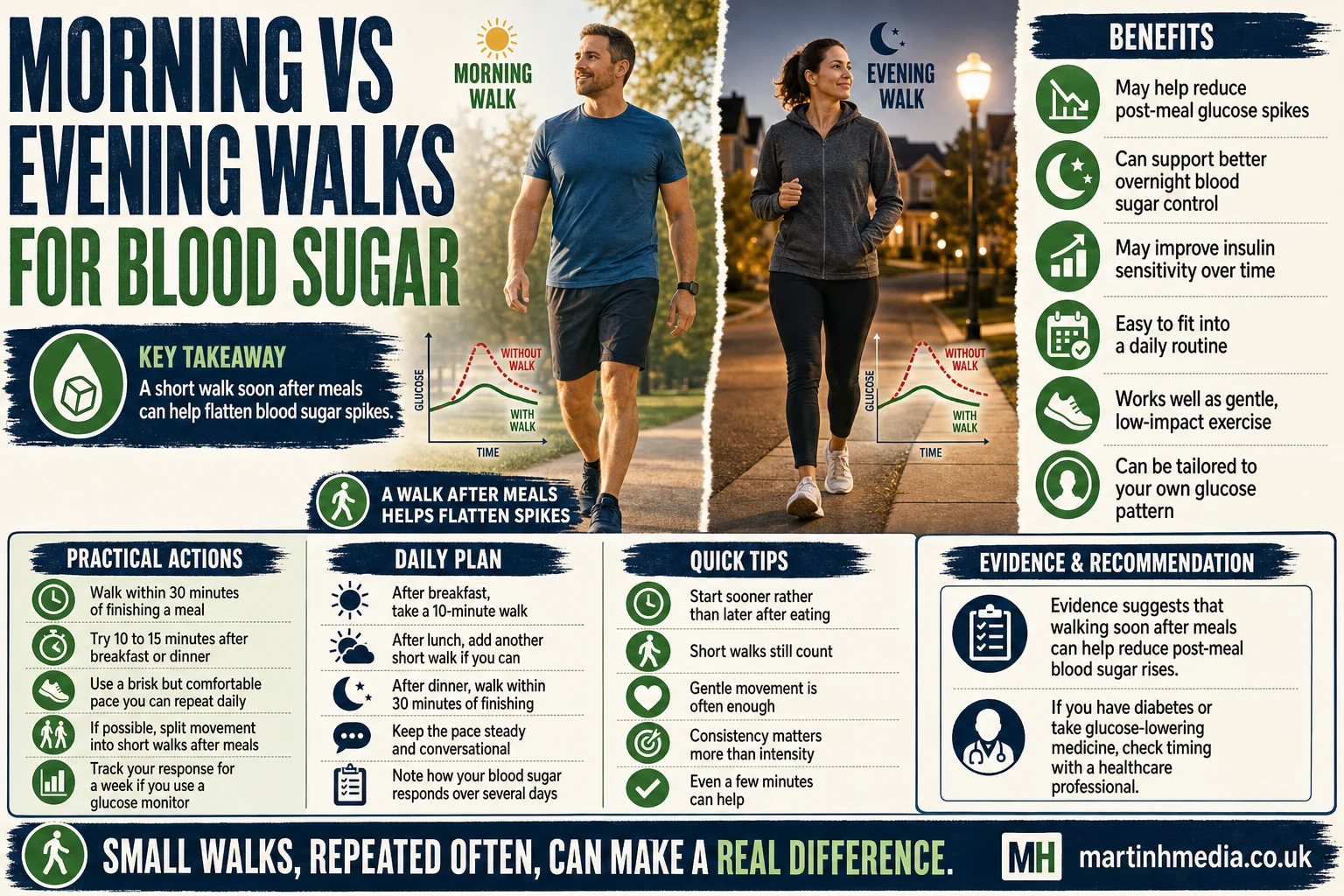
When You Walk Changes Your Blood Sugar More Than Distance
Morning vs Evening Walks for Blood Sugar shows different effects on glucose control. Your body responds to the same walk differently based on time of day. The window matters as much as the movement. Timing trumps distance for blood sugar management.
Morning vs Evening Walks for Blood Sugar: The Fasted State Advantage
Walking before breakfast happens when your glycogen stores are lower after an overnight fast. Your body leans more heavily on fat for fuel during this fasted state. This improves insulin sensitivity and helps your cells respond to insulin more efficiently over time.
Some people experience higher blood sugar in the morning when they wake up, called the dawn phenomenon. A brisk morning walk can help manage blood sugar early on, with 30 minutes reducing average fasting blood sugar levels.
The catch is what happens next.
Fasted morning walks may show a smaller drop in blood sugar than expected. Without recent food in your system, your liver releases glucose to keep your brain fueled. Walking signals for even more glucose release. Your body prioritizes keeping you alive over lowering numbers on a meter.
Plasma cortisol levels tend to be higher in the morning than in the afternoon. This may help explain why glucose levels tend not to fall with fasted exercise.
Morning exercise in the fasted state might be better for overall 24-hour glucose levels than exercise done at other times. This suggests greater utilization of stored fuel and improved whole-body insulin sensitivity in the 24 to 48 hours afterward.
Worth knowing: a morning walk builds better glucose handling tomorrow. It doesn’t always fix your numbers today.
Evening Walks for Blood Sugar: The Dinner Solution
Walking after evening meals appears more effective in controlling glycemic impact compared to no exercise. Walking immediately after dinner shows the strongest effect on blood sugar control.
Pancreatic function tends to reach a low point in the evening. This makes it harder for your body to clear glucose from dinner. A quick walk helps pick up the slack.
Your evening blood glucose level determines how much sugar will be in your blood while you sleep. If it’s high, it stays high throughout the night.
A single 45-minute morning walk produced about 8% reduction in blood sugar. Post-meal walks were uniquely effective at controlling the blood sugar spike after dinner. The difference comes down to when your body needs the most help.
Postmeal exercise halted further increases in postprandial glucose levels after the evening meal at 6 p.m. Postmeal walking was significantly more effective than 45 minutes of sustained morning or afternoon walking in lowering three-hour postdinner glucose.
Dinner creates your biggest glucose challenge. Evening walks meet that challenge head-on.
Most people sit immediately after dinner. This represents the worst possible scenario for overnight glucose control. Even standing helps, but walking delivers measurable benefits that compound while you sleep.
Morning vs Evening Walks for Blood Sugar: The Timing Window
The timing of postprandial walks is key for lowering blood sugar. Research shows that walking within 60 to 90 minutes after a meal is most beneficial, when blood glucose levels are at their peak.
Postprandial blood glucose levels typically peak within 30 to 60 minutes after glucose ingestion. A 10-minute walk immediately after eating significantly suppressed peak blood glucose levels. The previously recommended 30-minute walk showed no significant difference when started 30 minutes after eating. Exercise not being initiated immediately allowed postprandial glucose excursion to occur.
The window closes fast.
Exercise after meal ingestion led to a reduction in postprandial glucose excursions compared with exercise before eating. Pre-meal exercise did not lead to significantly lower postprandial glucose compared to an inactive control.
The time between meal and exercise had a moderating influence on postprandial glucose excursions. Walking has a greater acute beneficial impact on postprandial hyperglycemia when undertaken as soon as possible after a meal rather than before eating.
Start your walk within 30 minutes of finishing your plate. Walking after eating prevents the spike rather than fixing it afterward.
The best time to start walking after you eat is within 30 minutes. This helps control blood sugar as glucose from food moves into the bloodstream around this time.
The immediacy matters more than the duration for peak glucose management.
Morning vs Evening Walks for Blood Sugar: Duration and Intensity
Walking for 10 to 15 minutes after each meal can significantly lower blood sugar levels. Breaking up a 30-minute walk into three shorter sessions after meals may be more effective than walking all at once.
A 2016 study in Diabetes Care showed post-meal walks were more effective than a single daily workout in reducing blood glucose. A 2022 meta-analysis found that walking after meals can reduce post-meal blood sugar by up to 22 percent.
You don’t need marathon sessions.
Even a five-minute walk after eating had a measurable effect on moderating blood sugar levels. The beneficial effect was observed during a 60 to 90 minute window following the meal.
Low to moderate-intensity activity, like brisk walking, appears best for keeping glucose levels in check after eating. Walking depends on aerobic metabolism, which draws upon glucose in combination with fatty acids.
High intensity exercise may initially raise blood sugar by stimulating glucose production in the liver. Hard workouts trigger stress hormones. Your liver responds by dumping more glucose into circulation.
Keep it conversational. Gentle movement works better for glucose management than intense effort.
Both paces lower blood sugar, but brisk walkers had average fasting blood sugar of about 92 mg/dL compared to 103 mg/dL for slow walkers. HbA1c levels were 5.76 for brisk walkers versus 6.47 for slow walkers.
Pick a pace you can maintain daily. Consistency beats intensity for long-term glucose control.
Morning vs Evening Walks for Blood Sugar: The Metabolic Switch
Numerous studies have documented a circadian rhythm in oral glucose tolerance. It usually peaks in the morning and declines in the afternoon and evening.
The circadian system is important in regulating the daily rhythm in glucose metabolism. Disturbance of this control, such as in shift work or eating late, results in disturbed glucose control and increased type 2 diabetes risk.
Your body operates on an internal clock. This clock governs how efficiently you process glucose at different times. Morning offers better baseline glucose tolerance. Evening presents weaker glucose control when you need it most.
Different studies have observed improvements in overall health and glycemia from afternoon exercise compared with morning exercise in individuals with diabetes, particularly if vigorous-intensity exercise is performed.
The debate isn’t settled. Individual response varies based on diabetes type, medication timing, and personal schedule. Some people stabilize better with morning movement. Others need evening intervention.
Studies tested whether time of day would influence the metabolic response to exercise in individuals with type 2 diabetes in free-living conditions. Real-world results don’t always match laboratory predictions.
Test both windows with a continuous glucose monitor. Your personal glucose rhythm determines your optimal walking schedule. Managing blood sugar requires matching movement to your unique metabolic patterns.
Track your response for seven days. Morning walks might improve your fasting glucose. Evening walks will likely flatten your dinner spike. Most people benefit from both at different meals.
Walk for 10 minutes within 30 minutes of finishing your largest meal today.
Frequently Asked Questions
Should I walk before or after breakfast for blood sugar control?
Walking after breakfast controls the glucose spike from that meal more effectively than walking beforehand. Pre-meal walks don’t significantly lower postprandial glucose compared to staying inactive. Start your walk within 30 minutes of finishing breakfast for maximum impact on blood sugar levels.
How long should I walk after dinner to lower blood sugar?
Ten to fifteen minutes is enough to significantly reduce post-dinner blood sugar spikes. Even a five-minute walk shows measurable effects. The timing matters more than duration, so start walking within 30 minutes of finishing your meal rather than waiting an hour.
Can morning walks on an empty stomach raise blood sugar?
Yes, fasted morning walks can temporarily raise blood sugar in some people. Your liver releases glucose to fuel your brain during fasting. Walking signals for more glucose release without recent food to balance it. This effect is more common in people with type 1 diabetes.
Is walking after every meal better than one long walk?
Breaking up a 30-minute walk into three 10-minute post-meal sessions is more effective for blood sugar control than a single daily workout. Post-meal walks target the specific glucose spikes from each meal. One long morning walk doesn’t prevent your evening dinner spike.
What happens if I walk two hours after eating instead of immediately?
Walking two hours after eating is less effective at controlling the post-meal glucose spike. Your blood sugar peaks within 30 to 60 minutes after eating. Walking during this window prevents the spike. Walking later helps lower overall levels but misses the critical peak.