

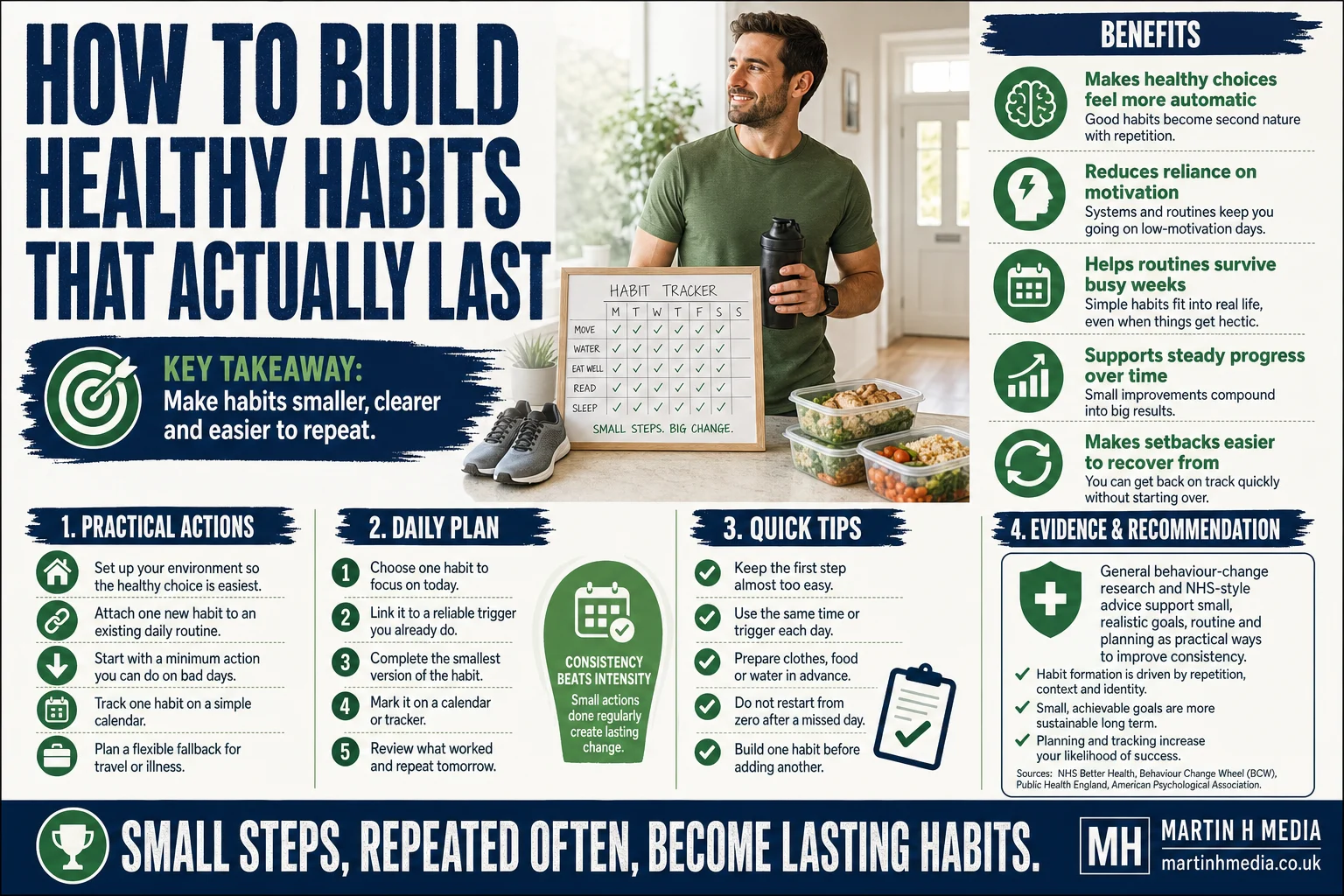
Why Your Healthy Habits Keep Failing (And How to Fix It)
You skip the gym twice and suddenly it’s been three months. Healthy living collapses the moment your schedule changes. Tips for Maintaining Consistency in Healthy Lifestyle Choice don’t need complexity. The answer sits in building automatic systems instead of chasing daily motivation.
Tips for Maintaining Consistency in Healthy Lifestyle Choice Through Environmental Design
Your kitchen setup decides what you eat more than willpower does. Place cut vegetables at eye level in your fridge. Hide chips behind sealed containers on high shelves. You’ll grab what you see first when hunger hits.
Most people blame themselves for poor food choices. The real problem lives in their environment. Easy access to junk food guarantees you’ll eat it eventually. Your tired brain takes the path of least resistance.
Prep your workout clothes the night before. Set them next to your bed where you’ll trip over them. This removes morning decisions when your willpower sits at zero. You see the clothes and your body starts moving.
Water intake improves when you carry a filled bottle everywhere. Buy three bottles and place them strategically. One stays at your desk. Another lives in your car. The third sits by your couch.
Remove temptation completely instead of trying to resist it. Don’t buy cookies hoping you’ll eat them slowly. They’ll disappear in two days. An empty cabinet can’t sabotage you at midnight.
The physical world around you shapes every health decision. Design spaces that make good choices automatic. This approach works when motivation dies after lunch.
Schedule-Based Systems Beat Mood-Based Decisions
Exercising when you “feel like it” means exercising never. Your calendar shouldn’t have blank spaces labeled “workout if motivated.” Block specific times like you would a doctor’s appointment.
Tuesday and Thursday at 6:30 AM becomes non-negotiable. The alarm rings and you move. No internal debate happens. Consistency beats motivation because the decision was made last month when you built the schedule.
Meal timing works identically. Eat breakfast at 7 AM daily regardless of hunger signals. Your body adapts to the pattern within two weeks. Erratic eating schedules keep your metabolism confused.
Sleep timing might matter more than sleep duration. Going to bed at 10:30 PM every night trains your circadian rhythm. Varying your bedtime by three hours wrecks recovery even if you sleep eight hours total.
Schedule your rest days with equal precision. Rest on Wednesdays and Sundays every single week. This prevents the common mistake of skipping workouts randomly until you’ve rested for nine days straight.
Time-based triggers remove willpower from the equation entirely. Your watch says 6:30 and your shoes go on. Weather doesn’t matter. Mood doesn’t get a vote.
Tips for Maintaining Consistency in Healthy Lifestyle Choice Using Minimum Viable Actions
Committing to sixty-minute workouts guarantees failure. You’ll skip them when life gets busy. Instead commit to putting on your workout shoes. That’s the only requirement.
Once shoes are on, you’ll usually complete the workout. But even if you don’t, you maintained the pattern. The habit stays alive through the smallest possible action.
Tell yourself you’ll walk for just three minutes. Getting out the door is the hard part. Most days you’ll walk for twenty once you start. The days you only walk three still count as wins.
Make your minimum action almost embarrassingly small. One pushup. Five minutes of meal prep. Drinking one glass of water. These actions feel too easy to skip.
People quit because they set the bar too high. They design perfect plans that demand perfection. Real life never cooperates with perfect plans. Your system needs to survive terrible days.
Build consistency through actions so small they feel trivial. These trivial actions compound into major changes over six months. Missing your ambitious goal breaks your streak. Completing your tiny minimum keeps momentum alive.
Tracking Creates Accountability Without External Pressure
A wall calendar with red X marks changed Jerry Seinfeld’s writing career. He marked an X every day he wrote jokes. The chain of X marks became its own motivation.
You don’t need apps or fancy systems. Print a monthly calendar. Mark days you complete your health action. Seeing fourteen consecutive marks makes you protect day fifteen.
Track one behavior at a time maximum. Tracking five things simultaneously guarantees you’ll abandon all five. Pick walking or pick vegetables. Not both yet.
The act of marking completion satisfies something in your brain. It provides immediate feedback for actions with delayed results. You won’t see fat loss for weeks but you see today’s X right now.
Share your calendar with nobody. This isn’t about impressing others. External accountability adds pressure and often backfires. You’re building automatic behavior that runs without external validation.
Review your calendar weekly. Count your completion percentage. Seventy percent is excellent. Perfection isn’t the goal. Sustained repetition is.
Tips for Maintaining Consistency in Healthy Lifestyle Choice by Linking to Existing Habits
New habits need anchors to survive. Attach your health action to something you already do daily. This is called habit stacking.
After you pour your morning coffee, do ten squats. The coffee acts as your trigger. You’ve poured coffee every day for years. That behavior is bulletproof. The squats ride along.
After brushing your teeth at night, prepare tomorrow’s lunch. Toothbrushing happens automatically. Food prep becomes the next step in an existing sequence. Your brain stops seeing it as a separate decision.
The formula is simple. After I do existing habit, I will do new health action. The existing habit must be absolutely consistent already. Don’t anchor to shaky behaviors.
Layer habits slowly. Add one every three weeks. Trying to stack five new habits onto your morning routine creates a house of cards. One missed step collapses everything.
Choose anchors that happen at the right time for your health action. Don’t stack evening vitamins onto your morning alarm. The timing mismatch guarantees you’ll forget.
Recovery and Flexibility Prevent All-or-Nothing Collapse
Missing one day doesn’t break anything. Telling yourself you’ve already failed definitely does. The all-or-nothing mindset kills more progress than actual obstacles do.
Plan for disruptions before they happen. Decide now what counts as completion during sick days. Maybe it’s just drinking enough water. That’s fine.
Travel and holidays don’t pause your system. They modify it. You can’t cook meals in a hotel. You can order protein and vegetables at restaurants. Adapt the behavior without abandoning it.
Two consecutive misses demand immediate action. Get back on track the third day no matter what. Three misses turns into seven extremely fast. Seven turns into permanent abandonment.
Your system needs built-in flexibility or it shatters under pressure. Understanding why consistency matters means accepting that perfect consistency doesn’t exist. Durable consistency does.
Give yourself permission to scale back without quitting. Half the workout beats no workout every time. This isn’t lowering standards. It’s maintaining the pattern that creates results.
Social Structures Support Habits Without Adding Pressure
Join a walking group that meets Tuesday mornings. You’ll show up when you don’t feel like it because others expect you. This is different from accountability pressure.
The group isn’t checking if you walked other days. They just walk with you on Tuesdays. That one guaranteed session per week anchors your entire routine.
Cook with a friend every Sunday afternoon. You prep meals together for the week ahead. The social time makes the task enjoyable instead of a chore. You keep the date because you value the friendship.
Choose social structures that feel like fun, not obligation. Forced check-ins with a trainer you dislike create dread. Dread builds resentment. Resentment destroys habits.
Tell close friends what you’re doing but avoid public declarations. Announcing goals on social media often backfires. Your brain gets a reward just from announcing, reducing motivation to actually do the work.
Find people already living the lifestyle you want. Spending time with them normalizes behaviors that currently feel hard. Their habits become your environmental cues.
Identity Shift Makes Choices Feel Natural
Stop saying “I’m trying to eat better.” Start saying “I’m someone who eats vegetables daily.” The language shift changes how you see yourself.
You don’t try to brush your teeth. You’re a person who brushes teeth. The same identity framework applies to any health behavior. Frame it as who you are, not what you’re attempting.
Each time you complete your action, you cast a vote for this identity. One workout is one vote for being an active person. Ten workouts make the identity harder to deny.
People who see themselves as healthy make different choices automatically. They don’t debate whether to take the stairs. Stairs align with their identity. The decision is already made.
Your identity follows your actions, not the reverse. You don’t need to believe you’re healthy first. Act healthy repeatedly and the belief follows naturally.
Focus on being consistent rather than being perfect. A consistent person misses occasionally but returns immediately. That’s the identity worth building.
Print a calendar today and mark the first X for any single health action you completed.
Frequently Asked Questions
How long does it take to build a consistent health habit?
Most automatic behaviors form between three and eight weeks with daily repetition. Simple actions like drinking water become automatic faster than complex ones like meal prep. Focus on maintaining the pattern rather than counting days. The habit solidifies when you do it without thinking about it.
What should I do if I miss several days in a row?
Return to your routine immediately without guilt or analysis. Complete your minimum viable action the very next day. Don’t try to compensate by doubling your effort. That approach usually leads to burnout and another break. Just resume the normal pattern as if nothing happened.
Can I work on multiple healthy habits at the same time?
Start with one habit and let it run for three weeks before adding another. Your brain can only automate so much at once. Stacking too many changes simultaneously depletes willpower and usually results in abandoning everything. Sequential habit building produces better long-term results than parallel attempts.
How do I stay consistent when my schedule changes frequently?
Anchor habits to actions rather than specific times when your schedule varies. Do squats after your first coffee regardless of when that happens. Pack vegetables for lunch right after you shower. These behavior-based triggers survive schedule chaos better than time-based ones.
Should I restart my tracking if I break my streak?
Keep your existing calendar and simply resume marking completions. Restarting from zero erases visible proof of your overall consistency rate. Seeing that you completed seventy percent of days over three months matters more than a perfect two-week streak. Track cumulative effort, not just consecutive days.